
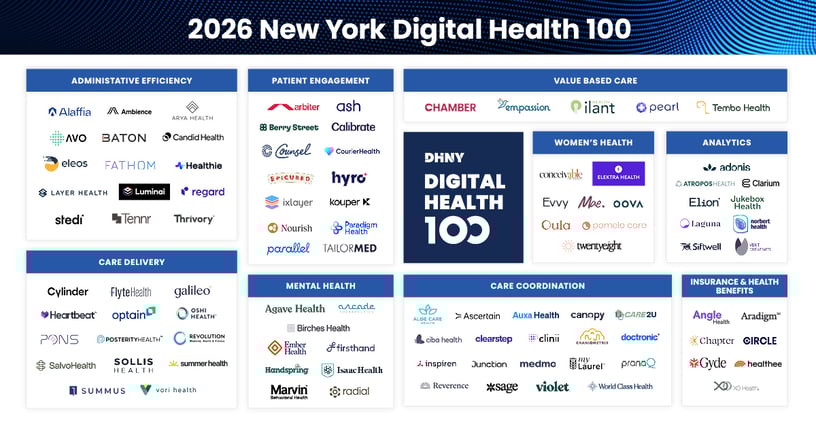
Canopy, the leader in Enterprise AI for oncology, announced today that it has been named to the 2026 New York Digital Health 100 (DH100) for the third consecutive year, an annual recognition honoring the most innovative and high-impact digital health startups in the New York region.
Canopy helps cancer centers manage the growing complexity of care by providing an Enterprise AI platform across patient services: triage, call center, front office, referrals, and pharmacy. By embedding AI and automation into existing workflows, Canopy enables faster issue resolution for patients, reduces manual work for staff, and helps practices capture sustainable reimbursement for this care.
Studies demonstrating the potential impact of Canopy’s platform on oncology patient experience in real-world settings have demonstrated:
- 22% reduction in ER visits and hospitalizations per 100 patient months1
- 22% - 45% improvement in treatment persistence at three months2
- 88% sustained patient engagement at six months3
- 52% reduction in infection-related hospitalizations in patients with hematologic malignancies, resulting in $977,695 in estimated annual savings per 1,000 patients4
- Improved early detection of toxicities with bispecific antibody therapies5
- Potential to improve adherence and manage toxicities associated with oral anticancer medication6
In 2025, Canopy’s contracted network grew to ~10% of oncology providers in the U.S. across 500+ unique sites of care. Recent partnerships include Utah Cancer Specialists, Willamette Valley Cancer Institute and Research Center, and USA Health Mitchell Cancer Institute—the first academic cancer center to join Canopy’s network.
"The breadth and depth of companies named to this year’s DH100 reflect a clear market shift from experimentation to execution. These companies are scaling solutions that improve outcomes while building enduring businesses, demonstrating how innovation at the intersection of care delivery, data, and trust is shaping the next generation of healthcare leaders."
—Bunny Ellerin, co-founder and CEO of DHNY.
About Canopy
Canopy is the leader in Enterprise AI for Oncology, providing practices with a unified platform for all the care that happens between visits and across patient services. Supporting ~10% of oncology providers in the U.S. across 500+ sites of care nationwide, Canopy enables practices to identify and prioritize patients who need help, resolve their issues using AI-native tools, and generate new reimbursement streams. For more information, visit www.canopycare.us.
About Digital Health New York (DHNY)
Digital Health New York (DHNY) is a connected community of digital health leaders who share ideas, spark new directions and create success across the entire ecosystem. As an organization, DHNY seeks to increase the visibility of New York City as a leader in healthcare innovation and showcase the companies and leaders creating the future of healthcare. Its flagship event, DHNY Summit, brings together an elite group of entrepreneurs, investors, payers, providers and executives to cultivate the New York digital health community and drive impactful conversations around the current and future state of digital health. DHNY was founded in 2022 in collaboration with AlleyCorp. For more information or to join DHNY’s mailing list, please visit www.dhny.co.
DH100 Methodology
To compile the DH100, DHNY invited companies to complete an in-depth application with both quantitative and qualitative measures to get to know the company better. DHNY also used its dynamic database of digital health companies in the region to round out the consideration set. A company qualified for consideration if it maintained headquarters or employed at least 5 people in the New York region. Companies were excluded if: public or non-profit; founded before 2015; on the DH100 five or more years; had an exit. DHNY evaluated companies on a number of factors, including but not limited to: strength of application, leadership, # of employees, funding, revenue, market fit, differentiated offerings, and community engagement.
Learn More
Interested in learning more about Canopy? Contact our team using the button below.
1 Kolodziej, M. A., Kwiatkowsky, L., Parrinello, C., Thurow, T., Schaefer, E. S., Beck, J. T., Cherny, N., & Blau, S. (2022). ePRO-based digital symptom monitoring in a community oncology practice to reduce emergency room and inpatient utilization. Journal of Clinical Oncology, 40(16_suppl), 1508
2 Parrinello, C., Calkins, G., Kwiatkowsky, L., Schaefer, E. S., Beck, J. T., Ellis, A. R., Blau, S., Telivala, B. P., & Kolodziej, M. A. (2022). Time on treatment is prolonged in patients utilizing an ePRO based digital symptom monitoring platform in the community setting. Journal of Clinical Oncology, 40(16_suppl), 1528. DOI: 10.1200/JCO.2022.40.16_suppl.1528
3 Cherny, N. I., Parrinello, C. M., Kwiatkowsky, L., Hunnicutt, J., Beck, T., Schaefer, E., Thurow, T., & Kolodziej, M. (2022). Feasibility of Large-Scale Implementation of an Electronic Patient- Reported Outcome Remote Monitoring System for Patients on Active Treatment at a Community Cancer Center. JCO Oncology Practice, 18(12), e1918-e1926. DOI: 10.1200/OP.22.00180
4 Essell J, Ascha M, Schaefer E, Calkins G, Kwiatkowsky L, Kolodziej M, Derman B. (December 6, 2025). Remote therapeutic monitoring reduces hospitalization due to infection in patients being treated for hematological malignancy. Presented as an oral presentation at the 2025 American Society of Hematology (ASH) Annual Meeting.
5 Derman, B. A., Essell, J. H., Kolodziej, M. A., Kwiatkowsky, L., Calkins, G., Parrinello, C. M., & Ascha, M. S. (2024, December 9). Electronic patient-reported outcome (ePRO) symptom monitoring for relapsed/refractory multiple myeloma in community settings, focusing on bispecific antibody therapy. American Society of Hematology Annual Meeting
6 Sharma, S., Doshi, G., Shumway, N., Schaefer, E., Dave, N., Marcus, A., Dyson, B., Derman, B., Essell, J., Ascha, M., Calkins, G., Neiman, J., Kwiatkowsky, L., & Kolodziej, M. (2025). Application of the remote therapeutic monitoring (RTM) platform to optimize adherence and manage toxicity of oral anti-cancer medications (OAM). JCO Oncology Practice, 21(suppl 10), abstract 594. DOI: 10.1200/OP.2025.21.10_suppl.594